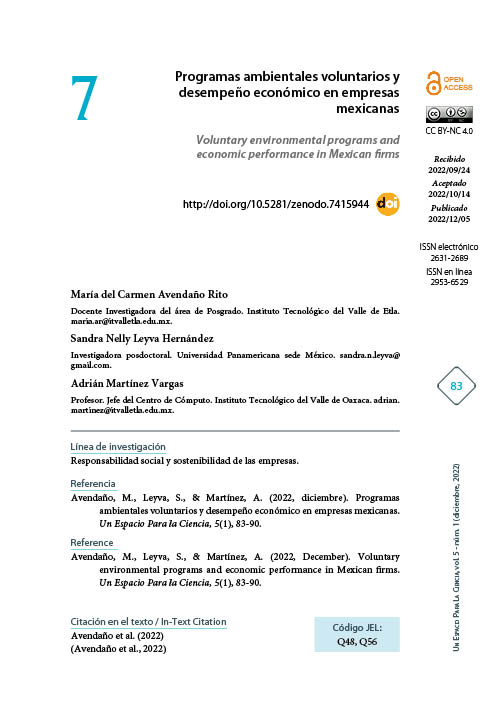
Voluntary environmental programs and economic performance in Mexican firms
Keywords:
Voluntary certification, Environmental Audit, Economic performanceAbstract
http://doi.org/10.5281/zenodo.7415944
In the last four decades, the literature on environmental performance and social responsibility has shown that environmental programs represent a tool that supports companies to improve their environmental and economic performance, however, in Mexico there is not enough empirical evidence to prove it. The main purpose of this research is to analyze the influence of voluntary environmental programs on the economic performance of Mexican companies; the literature argues that those firms that belong to a voluntary environmental program and are certified, reduce their consumption and save expenses; 45 firms were analyzed that are in the National Environmental Audit Program (PNAA) of the Federal Attorney for Environmental Protection (PROFEPA) and are in the ranking of the most successful companies in Mexico by CNN Expansion magazine in 2020; Through an ANOVA analysis of two factors, significant differences were found between environmental certification and the economic performance of companies, it is concluded that environmental certification positively influences the economic performance of companies, since it decreases their expenses by reducing their consumption.
Downloads
References
Aragón-Correa, J., Marcus, A., & Vogel, D. (2020). The effects of mandatory and voluntary regulatory pressures on firms’ environmental strategies: A review and recommendations for future research. Academy of Management Annals, 14(1), 339-365. https://bit.ly/3MyK1WL
Babakhan, N., Lee, A., & Dolnicar, S. (2020). Carbon labels on restaurant menus: do people pay attention to them? Journal of Sustainable Tourism, 28(1), 51-68. https://doi.org/jgtr
Conte, M., & Jacobsen, G. (2014). When do voluntary environmental programs succeed? Evidence from green electricity and all US utilities [Working Paper]. https://bit.ly/3CDn4Nz
Cochran, P. (2007, November-December). The evolution of corporate social responsibility. Business horizons, 50(6), 449-454. https://doi.org/dqvvxr
Frederick, W. (1960, July 1). The growing concern over business responsibility. California Management Review, 2(4), 54-61. https://doi.org/gfwn2f
Garriga, E., & Melé, D. (2004, August). Corporate social responsibility theories: Mapping the territory. Journal of business ethics, (53), 51-71. https://doi.org/drdvpm
Koh, P.-S., Qian, C., & Wang, H. (2014). Firm litigation risk and the insurance value of corporate social performance. Strategic Management Journal, 35(10), 1464-1482. https://doi.org/gg6t2b
Kramer, M., & Porter, M. (2006). Estrategia y sociedad. Harvard business review, 84(12), 42-56. https://bit.ly/3ezg5Ny
Melo, T., & Garrido-Morgado, A. (2012). Corporate reputation: A combination of social responsibility and industry. Corporate social responsibility and environmental management, 19(1), 11-31. https://doi.org/c8763g
Montiel, I., & Husted, B. (2009, December 19). The adoption of voluntary environmental management programs in Mexico: First movers as institutional entrepreneurs. Journal of Business Ethics, (88), 349-363. https://doi.org/b9sqdm
Mzembe, A., Lindgreen, A., Idemudia, U., & Melissen, F. (2020). A club perspective of sustainability certification schemes in the tourism and hospitality industry. Journal of Sustainable Tourism, 28(9), 1332-1350. https://doi.org/jgts
Orlitzky, M., Schmidt, F. & Rynes, S. (2003, March). Corporate social and financial performance: A meta-analysis. Organization studies, 24(3), 403-441. https://doi.org/fvssbx
Orlitzky, M., Siegel, D. S., & Waldman, D. A. (2011, January 11). Strategic corporate social responsibility and environmental sustainability. Business & Society, Forthcoming, 50(1), 6-27. https://bit.ly/3eBmUhB
Prakash, A. (2000). Greening the firm: The politics of corporate environmentalism. Cambridge University Press.
Prakash, A., & Potoski, M. (2012). Voluntary environmental programs: A comparative perspective. Journal of Policy Analysis and Management, 31(1), 123-138. https://doi.org/cppmt8
PROFEPA. (2016, 16 de agosto) ¿Qué es la auditoría ambiental? Procuraduría Federal de Protección al Ambiente. https://bit.ly/3VsHFfZ
Sharma, A., Mohan, S., Singh, S., & Prahalad, C. K. (2003, December 12). Case Study of CEMEX: Innovation in Housing for the Poor [Essay]. Department of Corporate Strategy and International Business. Michigan Business School. https://bit.ly/3VwwLpF
Testa, F., Iraldo, F., & Daddi, T. (2017, January 1). The effectiveness of EMAS as a management tool: A key role for the internalization of environmental practices. Organization & Environment, 31(1), 48-69. https://doi.org/gc33m9
Van’t Veld, K., & Kotchen, M. J. (2011, July 1). Green clubs. Journal of Environmental Economics and Management, 62(3), 309-322. https://bit.ly/3T506pw
Downloads
Published
Issue
Section
License
Copyright (c) 2022 María del Carmen Avendaño Rito, Sandra Nelly Leyva Hernández, Adrián Martínez Vargas

This work is licensed under a Creative Commons Attribution-NonCommercial 4.0 International License.